

Kegs Market Forecast 2026–2036: Global Industry to Reach USD 12.4 Billion by 2036 at 6.2% CAGR
Kegs Market
UK keg market grows at 6.5% CAGR, driven by pub upgrades, craft beer demand, flexible keg formats, and improved tracking and return logistics efficiency.
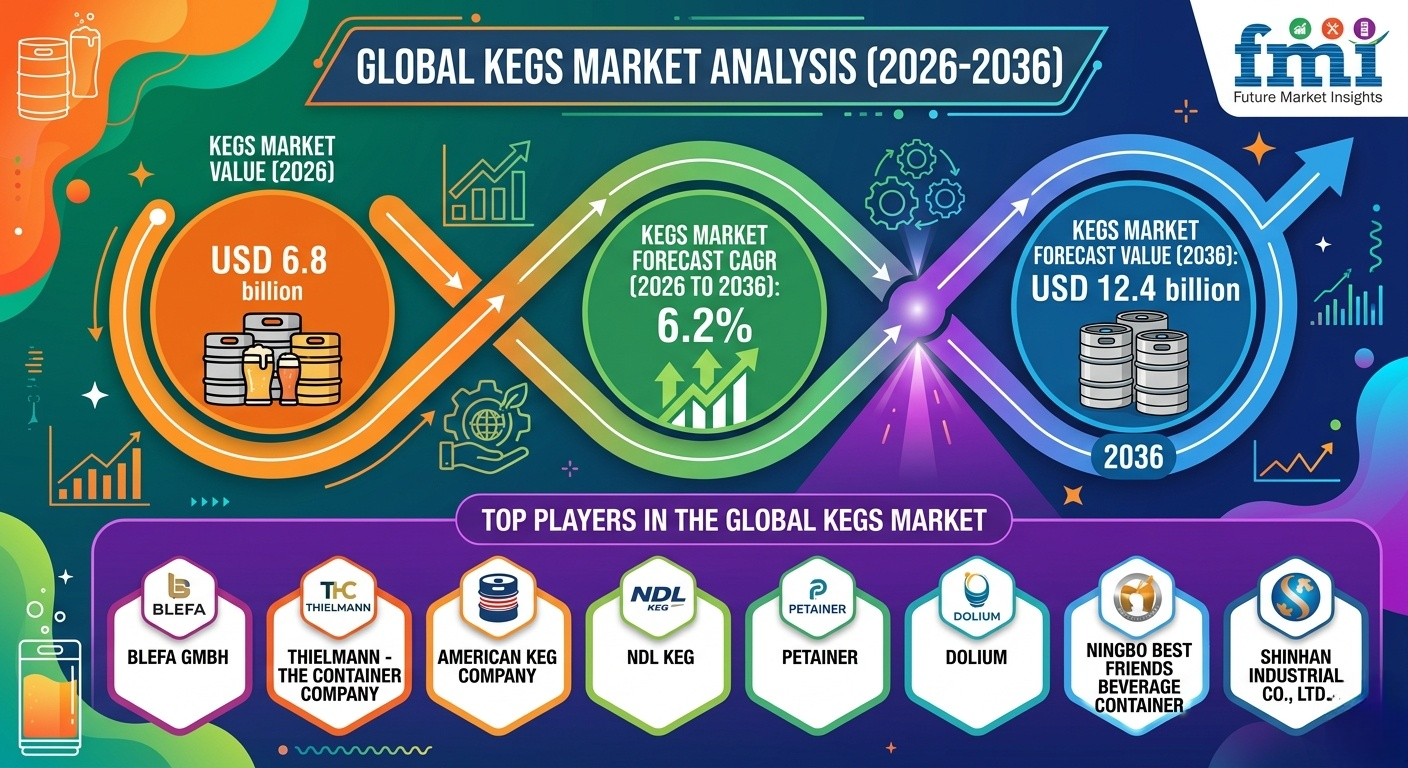
NEWARK, DE, UNITED STATES, March 24, 2026 /EINPresswire.com/ -- The global kegs industry is entering a new phase of steady expansion and operational transformation. Valued at USD 6.8 billion in 2026, the market is projected to reach USD 12.4 billion by 2036, growing at a CAGR of 6.2%. This growth is being driven by rising global demand for draft beverages, the rapid expansion of craft breweries, and increasing consumption across bars, restaurants, stadiums, and event venues.
According to a comprehensive strategic outlook from Future Market Insights (FMI), the keg industry is evolving from a traditional beverage container market into a logistics-driven, sustainability-focused packaging ecosystem. Reusable packaging models, smart tracking technologies, and lightweight keg innovations are reshaping how beverage companies manage distribution, cost efficiency, and environmental impact.
Discover Growth Opportunities in the Market – Get Your Sample Report Now
https://www.futuremarketinsights.com/reports/sample/rep-gb-6666
The Draft Beverage Economy: Growth Driven by Craft Brewing and On-Premise Consumption
The expansion of the keg market is closely tied to the global growth of draft beverage consumption. Draft beer continues to gain popularity due to its freshness, taste consistency, and premium experience compared to bottled or canned alternatives. As hospitality industries expand globally and craft brewing continues to grow, kegs remain central to beverage distribution infrastructure.
Microbreweries, brewpubs, and regional breweries rely heavily on kegs for local distribution, taproom operations, and event-based consumption. The rise of premium and specialty beers has further strengthened keg demand, as draft systems help maintain carbonation, flavor stability, and product quality from production to dispensing.
Industry analysts note that kegs are no longer viewed simply as containers but as circulating assets within beverage logistics networks, where efficiency, tracking, and lifecycle management are becoming critical profitability factors.
The Material Advantage: Stainless Steel Remains the Industry Standard
The keg industry continues to be dominated by stainless steel, which holds approximately 72% of global market share. Stainless steel kegs are widely preferred due to their durability, hygiene standards, and ability to withstand repeated cleaning, high pressure, and long usage cycles.
Despite higher upfront costs compared to plastic or polymer alternatives, stainless steel kegs offer long-term cost efficiency due to their extended service life and reliability. Breweries and beverage producers favor stainless steel because it integrates seamlessly with existing filling, cleaning, and dispensing systems used across global beverage distribution networks.
Key advantages of stainless steel kegs include:
• High durability and long lifecycle
• Excellent hygiene and food safety compliance
• Suitable for high-pressure carbonated beverages
• Reusable and environmentally sustainable
• Compatible with automated cleaning systems
While stainless steel remains dominant, lightweight PET and one-way kegs are gaining traction in export markets and event-based distribution, where reverse logistics and return shipping costs are higher.
Segment Spotlight: Beer and Ale Lead Global Keg Demand
From a beverage perspective, beer and ale account for 58% of total global keg demand, making them the primary drivers of the industry. Kegs are essential in beer distribution because they preserve carbonation, freshness, and flavor consistency throughout transportation and storage.
Bars, pubs, restaurants, and event venues rely heavily on keg systems to serve large volumes efficiently while maintaining product quality. The growth of craft brewing and premium beer consumption continues to reinforce beer’s dominance in keg usage.
Other beverage segments using kegs include:
• Wine
• Soft drinks and soda
• Coffee and cold brew
• Kombucha and specialty beverages
Cold brew coffee and ready-to-drink beverages are emerging as new growth areas for keg usage, particularly in cafés, offices, and hospitality venues.
Logistics and Asset Management: The New Competitive Battlefield
One of the biggest challenges in the keg industry is logistics management. Kegs operate in return-and-reuse cycles, which require efficient tracking, cleaning, storage, and redistribution systems. Lost, stolen, or misplaced kegs can significantly impact brewery profitability.
To address these challenges, manufacturers and beverage companies are investing in:
• Smart keg tracking using RFID and GPS
• Automated cleaning and sanitization systems
• Lightweight keg designs to reduce shipping costs
• Rental and pooling services to reduce capital investment
• Digital fleet management platforms
These innovations are transforming kegs from simple packaging containers into tracked, managed logistics assets, improving operational efficiency across beverage supply chains.
Regional Powerhouses: Europe, North America, and Asia Pacific
While Europe and North America remain the largest markets due to their strong brewing traditions and mature hospitality sectors, Asia Pacific is emerging as a major growth region driven by urbanization, rising disposable income, and growing beer consumption.
Key Country Growth Rates:
• China – 8.4% CAGR
• Germany – 7.8% CAGR
• Brazil – 7.1% CAGR
• Belgium – 6.8% CAGR
• United Kingdom – 6.5% CAGR
• United States – 5.9% CAGR
• Japan – 5.4% CAGR
China is currently the fastest-growing keg market, supported by rapid craft brewery expansion and increasing demand for draft beer in urban entertainment venues. Germany and Belgium continue to show stable growth due to strong beer culture and export-oriented brewing industries, while Brazil is emerging as a high-growth market driven by nightlife culture and expanding brewery capacity.
Dynamics of the Decade: Sustainability, Smart Tracking, and Lightweight Designs
Looking toward 2036, several major trends are expected to redefine the competitive landscape of the kegs market.
Sustainability and Circular Packaging:
Kegs align well with circular economy goals due to their reusable nature and long service life. Beverage companies are increasingly prioritizing reusable packaging formats to reduce waste and improve lifecycle efficiency.
Smart Kegs and Digital Tracking:
RFID tracking, IoT sensors, and digital fleet management systems are helping breweries track keg location, usage cycles, and maintenance schedules, reducing losses and improving asset utilization.
Lightweight and One-Way Kegs:
PET and polymer kegs are gaining popularity in export markets, festivals, and small-scale beverage distribution where return logistics are difficult or expensive.
Rental and Pooling Services:
Instead of purchasing keg fleets, breweries are increasingly using rental or pooling services, allowing them to scale operations without heavy capital investment.
Competitive Landscape: Manufacturing Quality and Logistics Services Define Market Leaders
The global kegs market is moderately consolidated, with competition shaped by manufacturing quality, material durability, distribution networks, and after-sales servicing capabilities. Market leaders are focusing on lifecycle cost efficiency, environmental compliance, and smart tracking technologies to differentiate their offerings.
Leading companies in the global kegs market include:
• Blefa GmbH
• Schaefer Container Systems
• THIELMANN – The Container Company
• American Keg Company
• NDL Keg
• Petainer
• Dolium
• Ningbo Best Friends Beverage Container
• Shinhan Industrial Co., Ltd.
Stainless steel keg manufacturers dominate the premium segment through precision manufacturing and long service life, while PET keg manufacturers compete through lightweight designs and export-friendly formats.
The Future of the Kegs Market
The kegs market is expected to evolve from a traditional beverage packaging industry into a logistics-driven circular packaging ecosystem. Growth will be supported by the expansion of craft brewing, increasing draft beverage consumption, sustainability initiatives, and improvements in smart tracking and fleet management technologies.
By 2036, success in the keg industry will not be defined solely by manufacturing capacity, but by asset management efficiency, lifecycle cost optimization, and sustainable packaging innovation. Breweries and beverage producers will increasingly rely on smart keg fleets, rental models, and lightweight designs to improve operational efficiency and reduce environmental impact.
Why FMI: https://www.futuremarketinsights.com/why-fmi
Explore More Research Reports by FMI
Plastic Caps and Closures Market - https://www.futuremarketinsights.com/reports/plastic-caps-and-closures-market
CPLA for Packaging Market - https://www.futuremarketinsights.com/reports/cpla-for-packaging-market
Biodegradable Packaging Market - https://www.futuremarketinsights.com/reports/biodegradable-packaging-market
Biodegradable Wrap Systems Market - https://www.futuremarketinsights.com/reports/biodegradable-wrap-systems-market
Sustainable Packaging Market - https://www.futuremarketinsights.com/reports/sustainable-packaging-market
About Future Market Insights (FMI)
Future Market Insights, Inc. (FMI) is an ESOMAR-certified, ISO 9001:2015 market research and consulting organization, trusted by Fortune 500 clients and global enterprises. With operations in the U.S., UK, India, and Dubai, FMI provides data-backed insights and strategic intelligence across 30+ industries and 1200 markets worldwide.
Sudip Saha
Future Market Insights Inc.
+1 347-918-3531
email us here
Legal Disclaimer:
EIN Presswire provides this news content "as is" without warranty of any kind. We do not accept any responsibility or liability for the accuracy, content, images, videos, licenses, completeness, legality, or reliability of the information contained in this article. If you have any complaints or copyright issues related to this article, kindly contact the author above.
