

Polyolefin Odor Removal Additives Market Price Outlook and Future Industry Trends (2026–2036)
Shift toward molecular odor entrapment technologies accelerates adoption across automotive interiors, packaging, and consumer goods applications
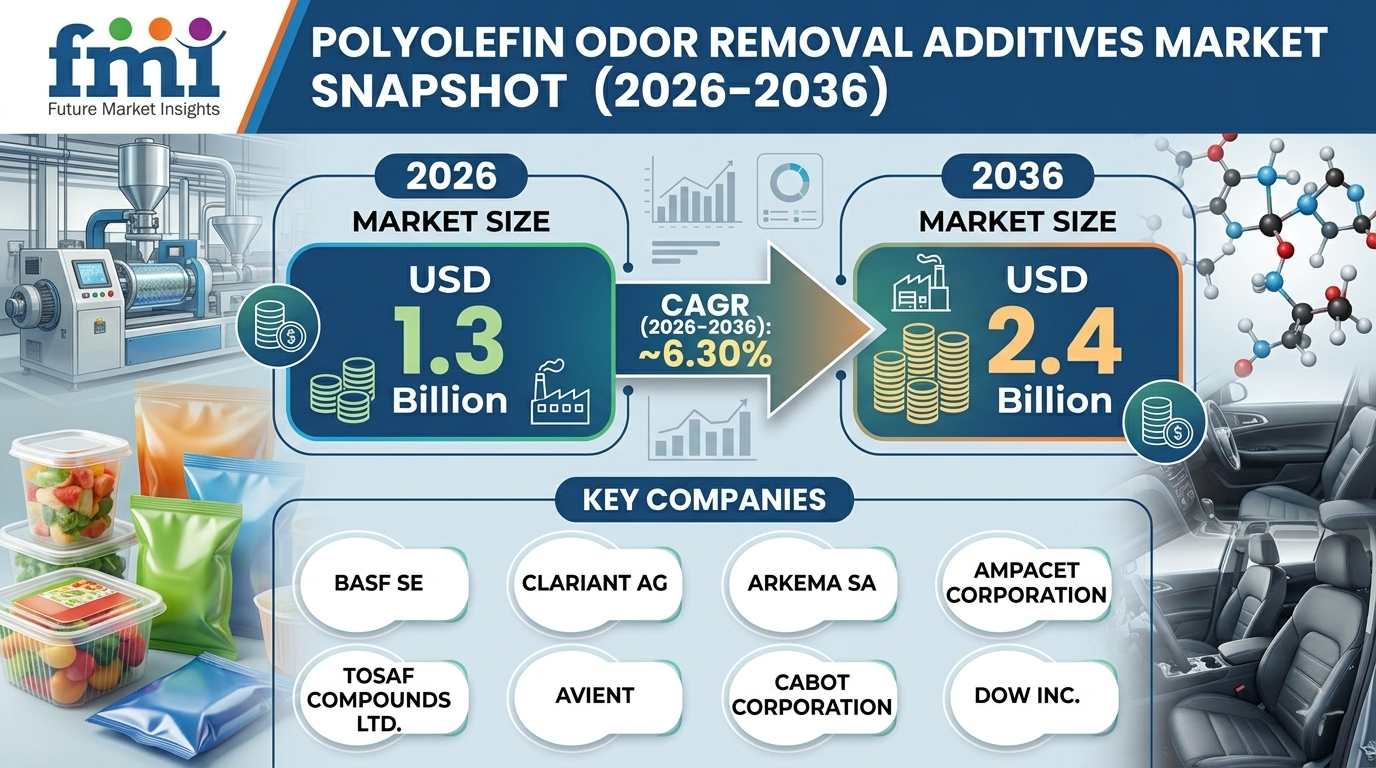
NEWARK, DE, UNITED STATES, March 20, 2026 /EINPresswire.com/ -- The global Polyolefin Odor Removal Additives Market is valued at USD 1.3 billion in 2026 and is projected to reach USD 2.4 billion by 2036, expanding at a CAGR of 6.30% during the forecast period. Growth is driven by tightening volatile organic compound (VOC) regulations, increasing recycled polymer utilization, and the transition from fragrance masking to permanent molecular odor neutralization.
As manufacturers across automotive and packaging sectors move toward zero-emission material standards, odor removal additives are evolving from optional enhancements into critical formulation components—ensuring compliance with strict air quality and organoleptic requirements.
Polyolefin Odor Removal Additives Market Snapshot (2026–2036)
• Market size in 2026: USD 1.3 billion
• Market size in 2036: USD 2.4 billion
• CAGR (2026–2036): ~6.30%
• Leading additive type: Zeolite-based formulations
• Top application segment: Automotive interiors
• Dominant polymer type: Polyethylene (PE)
• Fastest-growing country: India
• Key companies: Global specialty chemical and masterbatch producers
Market Momentum
The market begins at USD 1.3 billion in 2026, supported by increasing regulatory scrutiny on VOC emissions in automotive cabins and food-contact packaging. Between 2028 and 2030, rapid expansion of recycled polymer usage and stricter compliance requirements accelerate additive integration.
By 2032 and beyond, advancements in thermally stable scavengers and encapsulation technologies streamline qualification cycles for recycled materials. By 2036, the market reaches USD 2.4 billion, driven by widespread adoption of molecular entrapment systems across high-value manufacturing applications.
Request For Sample Report | Customize Report |purchase Full Report - https://www.futuremarketinsights.com/reports/sample/rep-gb-32283
Why the Market is Growing
The Polyolefin Odor Removal Additives Market is expanding as manufacturers face rising pressure to eliminate odor-causing emissions at the molecular level. Traditional fragrance masking methods are no longer sufficient, particularly in applications such as automotive interiors and food packaging, where even trace VOC presence can lead to product rejection.
Automotive OEMs now enforce strict parts-per-million thresholds for cabin air quality, compelling suppliers to adopt reactive scavengers. Similarly, packaging converters must ensure organoleptic neutrality when using recycled plastics, especially in food-contact applications.
Beyond compliance, procurement strategies are shifting. The cost of failing air quality or sensory tests now significantly outweighs the premium associated with advanced odor removal additives, making them a strategic necessity rather than a discretionary input.
Segment Spotlight
1. Application: Automotive Interiors Lead Demand
Automotive interiors account for approximately 38.6% of market demand, driven by stringent in-cabin air quality standards and high rejection risks during heat-soak testing.
2. Additive Type: Zeolite-Based Formulations Dominate
Zeolite-based additives hold around 45.2% share, owing to their thermal stability, high adsorption capacity, and ability to maintain polymer clarity without discoloration.
3. Polymer Type: Polyethylene (PE) Remains Core Segment
Polyethylene represents nearly 58.4% of demand, as large volumes of recycled PE require intensive odor remediation to meet high-value application standards.
Drivers, Opportunities, Trends, Challenges
• Drivers: VOC regulations, recycled polymer adoption, zero-emission material standards
• Opportunities: Food-contact recyclates, closed-loop appliance manufacturing, integrated masterbatch solutions
• Trends: Molecular entrapment technologies, qualification-driven procurement, high-loading additive systems
• Challenges: Additive-antioxidant interactions, thermal degradation risks, extended qualification timelines
Country Growth Outlook (2026–2036)
India leads growth at 8.2% CAGR, driven by rapid modernization of compounding infrastructure and export-oriented manufacturing. China follows at 7.4%, supported by scale advantages and domestic additive innovation.
The United Kingdom and Germany register steady growth at 6.5% and 6.1% respectively, driven by regulatory compliance and advanced automotive manufacturing standards. The United States expands at 5.8%, while Japan and South Korea grow at 5.4% and 6.0%, supported by precision engineering and integrated production systems.
Competitive Landscape
The market is highly competitive and technology-driven, with major players focusing on advanced formulation capabilities, emission testing validation, and polymer compatibility. Companies compete on their ability to deliver thermally stable, non-interfering additives that meet strict regulatory thresholds.
Key participants such as BASF SE, Clariant AG, Arkema SA, Ampacet Corporation, Tosaf Compounds Ltd., Avient, Cabot Corporation, and Dow Inc. dominate the landscape through deep integration with polymer processing and strong analytical validation capabilities.
Competition increasingly centers on emission reduction efficiency, compatibility with antioxidant systems, batch consistency, and the ability to support qualification-heavy supply chains.
Frequently Asked Questions (FAQ)
What is the global Polyolefin Odor Removal Additives Market size?
The market is valued at USD 1.3 billion in 2026 and is projected to reach USD 2.4 billion by 2036.
What is driving market growth?
Growth is driven by stricter VOC regulations, increased recycled polymer usage, and the shift toward permanent odor neutralization technologies.
What are polyolefin odor removal additives?
They are specialty chemical compounds designed to permanently neutralize or trap volatile organic compounds within polyethylene and polypropylene materials.
Why are these additives critical in manufacturing?
They ensure compliance with air quality standards, enable the use of recycled materials in high-value applications, and prevent product rejection due to odor or emissions.
Explore More Related Studies Published by FMI Research:
Anti-Yellowing Masterbatch for rPET Market https://www.futuremarketinsights.com/reports/anti-yellowing-masterbatch-for-rpet-market
Heat-Resistant PCR ABS Market https://www.futuremarketinsights.com/reports/heat-resistant-pcr-abs-market
Demand for Bioplastics in UK https://www.futuremarketinsights.com/reports/united-kingdom-bioplastics-market
About Future Market Insights (FMI)
Fture Market Insights, Inc. (FMI) is an ESOMAR-certified, ISO 9001:2015 market research and consulting organization, trusted by Fortune 500 clients and global enterprises. With operations in the U.S., UK, India, and Dubai, FMI provides data-backed insights and strategic intelligence across 30+ industries and 1200 markets worldwide.
Why Choose FMI: https://www.futuremarketinsights.com/why-fmi
Sudip Saha
Future Market Insights Inc.
+1 347-918-3531
rahul.singh@futuremarketinsights.com
Legal Disclaimer:
EIN Presswire provides this news content "as is" without warranty of any kind. We do not accept any responsibility or liability for the accuracy, content, images, videos, licenses, completeness, legality, or reliability of the information contained in this article. If you have any complaints or copyright issues related to this article, kindly contact the author above.
